Women Teaching Women Technology II: Ladies Learning Code

by Jen Lindner

Heather Payne founded Ladies Learning Code in June 2011 with a single tweet. A graduate of the Richard Ivey School of Business, she built her first WordPress blog while pursuing a graduate degree in International Relations in China.

What motivated you to start this, and how difficult or easy was it to get off the ground?

I started Ladies Learning Code by accident. I was eager to learn some programming skills, and after attending the first-ever Pyladies workshop while I was in LA on business, I tried to find a similar group in Toronto upon my return home. I was surprised when I didn’t find anything, so I wrote a blog post about how Toronto needs a group for women who want to learn beginner-friendly programming skills and tweeted it out. I started receiving emails, and 85 people ended up signing up for the first event. I was blown away.

My team at Ladies Learning Code works really hard to run awesome monthly events that people like, but we would all tell you that we’re surprised at how easy it’s been to get the word out about what we’re doing. The only way people find out about Ladies Learning Code is through social media and word of mouth (and lately, though the media). In four months, we’ve assembled a community of almost 1000 people. About 200 of those are developers and other technical folks who want to help out by volunteering at a workshop. The support from Toronto’s tech community has been incredible.

What informs your choices in curriculum – is marketability or ease of learning or merits of the technologies themselves? What informs your teaching technique choices?

So far, we’ve covered JavaScript, HTML & CSS, Ruby and WordPress – and all of those workshops have sold out in less than a day. (Actually, the WordPress workshop sold out in three minutes!) We select the topics based on who steps up to lead a workshop and what people are asking for. We also like our workshops to be hands-on, so we consider which languages or topics will make it possible for our participants to feel as though they’ve completed something by the end of the day.

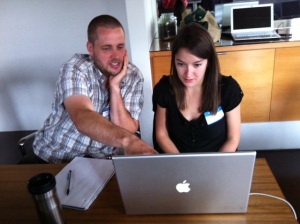
As for our teaching technique choices, we’re still iterating (although, what we’ve done so far seems to be working really well). The key, I think, is our 4:1 student-to-instructor ratio. Four participants sit at a table with a developer and they work together throughout the day. It’s more fun, because it gives everyone a chance to get to know each other. It makes for a better learning experience for the participants too, because the developer can offer challenges to participants who are catching on quickly, and offer more help to those who need it. What we’re finding is that our volunteer developers have as much fun as our participants!

Do you see a strong crossover in women who want to learn technology and women who want to start their own technology-fueled businesses, or are those more likely to be different camps?

We’re finding that there are a lot of reasons why women (and men) want to attend Ladies Learning Code workshops. For many of them, it’s curiosity. In general, our participants are super tech-savvy, and they want to learn more about the technologies they use every day. Some people definitely attend because they want to have a startup one day (or next week!), but some attend just because they want to be better at their job. Some are looking to upgrade their skills and add something new to their resume. And there is definitely a number of people who come because they work with developers, and they want to be able to do a better job communicating with them.

Do you see any social/cultural changes in your larger tech community resulting from LLC’s work? Is it any more comfortable for women, and/or for men (or not)? Is there a more visible presence of women?

I think it’s too soon to tell. There’s no doubt that Toronto’s tech community has been incredibly supportive of Ladies Learning Code, which is a great first step, but since we’ve only been around for five months, we’ll have to wait and see if our efforts result in a tangible difference. Of course, I’m a big believer in the power of communities, and ours is definitely a strong & passionate one. I believe that what we’re doing in Toronto is going to make a difference here. Especially as we diversify our offerings and target different demographics, especially girls.

Is there a strong online component to your program, or forums for questions and technical support? Do the women you train stay in touch with you and each other? What have you learned while doing this? What advice would you give on teaching to other groups or individuals who would like to do this themselves?

At the moment, there is no online component to Ladies Learning Code (other than the informal community on Twitter and Facebook). It’s something we’re thinking about. Many of the women who attend Ladies Learning Code workshops stay in touch. We have quite a few women who have attended two or more workshops, and we are all starting to recognize each other at tech events in the city, which is fun. Since our community is made up of people who are generally very social media-savvy, many of them connect on Twitter before, during or after events, and stay in touch that way. It’s another area that we might look to improve in the future.

The biggest thing we’ve learned while getting Ladies Learning Code off the ground is how much is possible, as long as you have a community that supports you. It’s been really exciting to build Ladies Learning Code over the past few months, but none of it would be possible without Toronto’s super supportive tech community. We’re so grateful to our community partner, The Centre for Social Innovation, for helping make our workshops accessible by providing us with amazing spaces to use for our workshops, and to the companies who have supported us, and of course to the developers who are giving up their Saturdays to help us inspire and empower more women to become builders – not just consumers – of technology and the web.

The biggest piece of advice I would give to someone who wants to start a group like Ladies Learning Code in their city is to think community first. Don’t think about the workshops you’re going to run, or about building a website, or getting a Twitter handle or a Facebook Page. We did all of that weeks after our first event – a brainstorming session. By bringing together a group of like-minded people and asking them what an organization for women who want to learn to code should look like (and even giving them markers and big pads of paper and having them breakout into groups and tackle different pieces of the puzzle), we got a better sense of what to build, but also brought together a group of people who cared about it and wanted to see it come to fruition.

Heather Payne, Founder
Women Teaching Women Technology II: Ladies Learning Code

Women Teaching Women Technology: Three Trailblazing Organizations

by Jen Lindner

It’s a moment of historical paradox in gender and technology: On the one hand, the number of women entering STEM higher education programs and fields is dropping. And the sexism women face in STEM professions is well-documented, as is the result: 52% leave because of hostile macho culture. But on the other hand, the innovative and enormously successful CS program at Harvey Mudd College is a shining example of gender balance. And there’s a rapidly growing movement of women teaching women technology skills: all over the Americas self-starting organizations are running hands-on classes to huge success. Coinciding with a rising tide of newcomer-welcoming efforts, there’s no question that enthusiasm for women doing web technology is growing.

Maybe we here at RailsBridge are incurable optimists, but we see the rise of women teaching women to code as a pony worth betting on. Girl Develop It, Ladies Learning Code and Web Start Women are all great examples of start up savvy applied to gender in tech. This is the first in a series of interviews with each of these organizations. Watch for these recurring themes: breaking down fears about technology, building confidence, support from their local technology community, the success of hands-on teaching techniques, and changing relations between women and men.

Girl Develop It

Founded in 2010 in New York by Sara Chipps and Vanessa Hurst, GDI has expanded to Austin, Columbus and Philadelphia – and even beyond the States to Ottawa, Canada and Sydney, Australia.

Alexis Goldstein and Izzy Johnston are both experienced software engineers and GDI instructors.

Which of GDI’s teaching techniques do you think work best?

Alexis:
Our emphasis on making the space non-intimidating. Just by saying that over and over, it encourages questions students may otherwise be afraid to voice.

What informs GDI’s choices in curriculum – is marketability or ease of learning or merits of the technologies themselves?

Alexis:
Our main aim is to encourage women to program, so our curriculum is mostly based around laying the proper foundation to support future learning.

Izzy:
The first and most important factor is student interest. We are very open with our students and have an ongoing dialog about their needs. We want our classes to empower students and equip them to face technological challenges in their careers and lives.

All of my classes blend teaching the theory via an interactive lecture and allowing students to play with the code in class as part of a lab. Besides teaching students how to learn languages, we also want them to leave every class with the feeling that they have built something that they can be proud of.

Are GDI classes comfortable for women, and/or for men (or not)?

Alexis: I do think it is a very comfortable experience for the women in the class. I also teach classes that are mostly men, and I find that the women who’ve taken classes with me both in and outside GDI tend to prefer the GDI class. One of my favorite by-products is watching the men (who are normally the minority in a GDI class) adjust to being in a predominantly female environment. I do think it’s a unique experience for many of them, and I suspect it does inform their behavior.

Do you see any social/cultural changes in your larger technology community resulting from GDI’s work?

Izzy: I have had multiple students come back to me months after taking my course to tell me that they were able to get a new job or that they received a promotion because of the class they had with me. But we want our students to reap more than just financial rewards. We want people who might be uncomfortable with the traditional world of computer science to learn they can improve their lives and the lives of those around them with the knowledge and the confidence that they have gained.

And I have seen more women attend hackathons, go to NY tech meetups, and generally participate in the tech scene. There is nothing more rewarding as an instructor to see than a student gain confidence and be able to insert her/himself into a conversation that they felt they couldn’t be a part of before.

Do the women you train stay in touch with you and each other?

Alexis: Some of them do send me their websites and projects after the class, which I always enjoy seeing. It’s wonderful to see their end product and what they’re able to do with the skills they learn.

Izzy: Many of my students email me today with a variety of questions. We also have a growing community of people on Twitter who support one another well after the courses they have taken.

What have you learned while doing this? What advice would you give on teaching to other groups or individuals who would like to do this themselves?

Izzy: I’ve learned that the most important gift you can give a student is not knowledge of a specific language but knowledge that they are capable of learning a language. I would advise anyone who wants to be involved in instruction that the first issue you have to address is never about the language. Not “What is a variable?” or “What does a for loop do?” The first issue you have to address is making sure each person in the room believes that they are capable of learning everything you are about to tell them. From your curriculum, to your slides, to your attitude–create a class that builds confidence at every step.

Alexis Goldstein
Izzy Johnston

More about the instructors: Alexis had conducted training sessions during her seven years as software developer on Wall Street, though most of them were via phone conferences. Teaching in a formal setting was new to her, though something she’d always wanted to do. Izzy has over seven years of instructional experience in software development and has been coding for twelve, and is also obtaining her Master’s at Pratt in Information and Library Science.

Women Teaching Women Technology: Three Trailblazing Organizations

Hungry Academy: get paid to learn Ruby/Rails

Programs where people can get paid to learn the craft of software development have started to become a trend. Like many great inventions, such as holography and test-driven development (TDD), it was independently “invented” by different people in different places. The idea of a software development apprenticeship where you learn on the job on the path to being hired has been an on-going, practical experiment by many companies. At Blazing Cloud, we’ve run four sessions of a cross-training program, Dave Hoover wrote Apprenticeship Patterns based on his own experience, and Code Academy, which is not affiliated with a specific company, just wrapped up its first session.

Now, LivingSocial is teaming up with JumpstartLab to offer a new program in Washington, D.C. that they call “Hungry Academy.” With just a week left for people to apply, I took time out today to interview Jeff Casimir from JumpstartLab who will be leading the training.

What’s Hungry Academy all about?
It’s a five-month, full-time, paid training program put together by JumpstartLab and LivingSocial. 24 attendees will be selected for the program and will divide time between classroom instruction, team project work, and open source / community contributions. Instruction will be led by Jeff Casimir and Matt Yoho from JumpstartLab.

We’ll focus on Ruby, Rails, and related technologies. And while some participants will have CS backgrounds, we expect others to have no programming experience whatsoever. You bring the passion and drive, we’ll help you develop the skills.

It starts in March and applications are being accepted until January 9th.

You say that people don’t need any programming experience to apply, how will you balance teaching people who have programming experience in other technologies with students who have never coded before?
From my background teaching middle school and high school, I’m accustomed to pushing people of drastically different abilities. Good teaching is individualized, so it doesn’t matter that people have varied skill-sets. As long as you plan for it, pushing people at their own “right pace” is possible.

What happens after the program?
If you successfully complete the program you’ll join the engineering team at LivingSocial as a full-time developer.

And what happens if they are unsuccessful?
We can’t guarantee jobs, but if you fail then I fail. LivingSocial would love to hire everyone from the program if they can prove their mettle. I promise that anyone who comes with the right attitude and works hard will be ready at the end.

Is it remote or on-site? Do I have to stay in DC?
All attendees need to be on-site daily at the office in DC. If you complete the program and join the team, there are likely opportunities in DC, Seattle, and maybe Boulder, Portland, and Austin.

Why “Hungry Academy”? Are people allowed to eat?
It’s a little weird, admittedly, but LivingSocial came out of a company named “Hungry Machine”. “Live Hungry” is still one of the core values — it means constantly striving to do better. We’re focusing on people who are passionate about their work, want to learn and grow, and can be awesome team members — that’s being Hungry.

How does someone apply?
All of the info is at hungryacademy.com. Please be sure to read the instructions in the job description.

In the application it says that a video is required. What do you think about research that indicates that people screening job applications with a photo of the applicant are biased toward white men?
Yeah, I decided that the application should be a video. Words on a page are just too easy to fake and too boring to read. Under the premise of hiring non-programmers, we’re basically taking people who, on paper, are not qualified. There’s little you can do on a resume to say “I am hungry and ready to kick butt,” it’s just a boring list of what you’ve done and which schools you owe money to. In the video we can see the evidence of your passion and hear it in your voice.

We don’t have an idea of what developers should “look like.” If anything, my concern is that we’ll be biased against those who fit the stereotype of developers. Both LivingSocial and JumpstartLab believe strongly in diversity because, at the core, both companies rely on creative ideas. Creativity is cultivated best when there are many inputs allowed to mix together, not one dominating profile.

In the end, we love people in all their genders, shapes, sizes, colors, creeds, and preferences. If you do too, then you’ll fit in here.

What’s the deadline again?
Applications are due Monday 1/9 and the program starts in March.

What if I have more questions?
Email me at contact@jumpstartlab.com and I’ll get back to you ASAP.

Hungry Academy: get paid to learn Ruby/Rails

Doing it Right: Harvey Mudd’s Gender-balanced CS Program

by Jen Lindner

What is Harvey Mudd doing so right, you ask? Well, we’ll tell you:

Since 2006, the percentage of female computer science majors has more than tripled, to about 40 percent.

This is because of revolutionary changes in the program designed to build confidence during the early stages of learning. Intro to CS, a requirement for all incoming students, is now broken into three sections – one for total beginners, one for those with some programming experience and one geared toward biology. This “minimizes mistaking familiarity for aptitude and the negative impact that mix-up has on inexperienced students’ confidence.” Assignments are aligned with students’ existing interests to illustrate and enhance the fun of programming. A research project is now offered much earlier, to sophomores — giving them exposure to mentors and the value to be gained by applying even basic skills in real-world CS problems. And a trip to the Grace Hopper Celebration of Women in Computing is offered, introducing women students to the vibrant community of professional women Computer Scientists. All of these things provide a broader experience of the field, and promote students’ belief in their abilities through their own experiences — something women are less likely to have because of cultural barriers to gaining it.

This is an interview with Christine Alvarado, one of the professors who has engaged in this ground-breaking new program.

How long you’ve been teaching? Have you taught at other institutions besides Harvey Mudd?

I got my undergraduate degree from Dartmouth College and my graduate degrees (MS and PhD) from MIT. I joined the HMC faculty in 2005. I actively taught for 6 years, and now I’m on sabbatical at Georgia Tech. Next fall I’ll be leaving HMC for a tenured teaching faculty position at UCSD. All of these positions have been in computer science (and all of my degrees are in CS as well).

What has your experience been like with the new curriculum and techniques?

My experience has been very positive. Of course, any time you completely change a course (in this case the first course in computer science) it’s difficult at first, but this change was actually easier than major changes to other courses, probably because of the fact that we had so many people working on the new course.

Was the transition difficult or smooth?

Perhaps surprisingly, it was quite smooth. One reason is probably that we were all really excited about the new course. Another was that I think that almost immediately the students really liked it. It’s always easier to make a transition when both the faculty and the students are behind it.

How has the change impacted the department socially and culturally?

This is more at the college-wide level, but I think there’s a much more positive attitude toward computer science now that we have this new version of CS5 (the first CS course). Prior to the change, CS5 was something that many students just survived (though many students also loved it). Now, almost every student at least appreciates the class, and many more love it, even if they do not go on to become computer science majors.

Within the department we have a much more diversity in the students who choose to major in CS. For one, almost 40% of our majors are women (previously it was around 12%). But more than that, we have many more students who had never considered studying computer science, so there’s sort of a “fresher” attitude toward CS that contrasts with the students who have been doing CS for years before college. Neither culture/attitude is better, it’s just that now there’s more perspectives within the major.

Do you see men and women relating differently? Is it more comfortable for women? For men as well as women?

I think that there is a general difference (which of course doesn’t hold for every male or ever female), but I think this difference has more to do with their experience before coming to college. I think the major is much more accepting now of students of either gender who are newer to the discipline. Students who come in with less experience (who tend to be women more often than men)
approach the discipline with a little more trepidation, but also more fresh excitement. I think that these students don’t feel as isolated in their views as they once did.

Would you say students’ relationships to their machines are changing because of the emphasis on personally relevant projects and fun?

I’m not really sure here. I know that they have fun within the class, but I can’t say whether that changes their relationship to their computers more generally.

And lastly, of the things that are working, how would you suggest we can implement them in grassroots trainings that are often one-time or short-running endeavors?

One thing might be to help students see how broad the field of computer science really is. That it’s more than just programming, and certainly more than just programming in a specific way. There are other hard and intellectually stimulating challenges to be addressed.

Professor Christine Alvarado
Doing it Right: Harvey Mudd’s Gender-balanced CS Program

27th Workshop!

by Jen Lindner

We’ve taught over a thousand women in 27 workshops across the country, and inspired women in the Python and Scala communities to begin doing the same. Right on!

Last weekend at Engine Yard San Francisco, 39 students learned how to build, commit and deploy a Ruby on Rails application and now have access to the Railsbridge network of technical support. Today we’re posting what some of the students and volunteers had to say about the experience.


Cathy – student and first time organizer

I was totally impressed by the organization, the curriculum, the volunteers and the fun and ease with which the participants got the concepts. I was in the beginner class since I haven’t programmed anything in over 10 years. It was fun – the curriculum was great and the teachers/TAs were so happy to help me when I got stuck and just tell me cool things about Ruby and tricks with using the editor. I was inspired that I got it and it makes me want to do more.

The participants and volunteers were super cool and easy to be with. I had the feeling that what the organization values people just being themselves. I heard many peers mention how safe it was and how taken care of they felt. I felt that way too. When you’re trying to learn something new – something that’s potentially difficult, like programming, it makes a ridiculous huge difference to know that you can ask a question if you’re stuck – you don’t have to pretend to have anything figured out!

I hope many more women get a chance to participate.


Alison – student

What made you want to attend the workshop?

It’s a unique opportunity for women. I just wanted to become more technical. I’m a business consultant and my clients are always wanting to integrate with stuff – I need to be able to speak the language and become more technical in my current work.

What did you expect – what was unexpected?

I didn’t expect the TA ratio to be so high. There is always someone to move you along. And I didn’t expect to be put in groups with people who are at my level – that’s great.

What do you recommend about it?

Since it’s open to all skill levels, all experience, you just need a laptop and you can move at your own pace.


Tammy – student

Who would you recommend this to?

I would recommend this to anyone who’s interested in technology, and to people who work with technologists.

How it’s going?

It’s awesome – I’m really enjoying it and learning a lot – I’m at a very basic level because I don’t have any programming skills and the TAs are really good about teaching the basic things that can really slow you down.

How would you describe the experience to others?

Everyone is so nice. The teachers are great , no judgement – it’s like “Okay, let me tell you.” Sometimes at work with engineers – they don’t have the same reaction.

Is there anything you would change?

I would like to learn more about Rails.


Nina – student

What are you inspired by?

The space is awesome, I was impressed that there is so much space and everyone is comfortable. The new curriculum is nicely formatted – the change from the wiki to an application is cool and it’s a good structure.


Amy – first-time volunteer teacher
Amy works for Engine Yard in Portland.

What made you want to volunteer?

I’ve been encouraging women to work in high tech for many
years. And especially since I joined Engine Yard, I’ve
been wanting to give more back to the Ruby community. I’d hoped to get
involved with Railsbridge organization in San Francisco (before I
moved to Portland). This weekend’s workshop was a golden opportunity
to gain experience, which I can contribute to Portland’s women’s Ruby workshops.

How was teaching?

Great! And co-teaching worked really well.

What are you taking away from this workshop?

I’m excited to have met so many inspiring and inspired women.

Who would you recommend this to?

Many people! Especially women who are working in a technical field but don’t have a programming background.

What are you inspired by?

The collaborative atmosphere and people teaching each other, people getting confidence.


Railsbridge workshops are an open source project. We are individuals who volunteer their time and work to make these events happen. All of the materials are open source and we welcome feedback.

Installation instructions

Curriculum

Want to stay informed about our workshops? Sign up for announcements on our mailing list.

27th Workshop!

Seattle RailsBridge – Growing, Growing!

by Elise Worthy

Seattle RailsBridge has been gaining great momentum – the women’s outreach workshops are growing in size, sponsorship*, and community support.

A couple of weeks ago, we held the second Seattle RailsBridge workshop, which had 25 students and 20 teachers/TAs.

railsbridge-group

Sonia, one of our awesome volunteers, wrote up the following review of the event:

I just got back from the second Seattle RailsBridge and I wanted to tell you all how well it went. Very!

Even the weather cooperated by being overcast and foreboding, making us all feel just fine about spending Saturday inside writing code.

The curriculum (http://seattlerailsbridge.heroku.com/toc) was very clean, well-thought-out, and entirely achievable in the given time without being trivial. The color-coded structure of the lessons made each one easy to follow, and the “What Just Happened?” sections were a wonderful way to sum up each step. Well done!

After the class one of the students who I had worked with praised the class effusively. She said, “I felt like I could ask anything and I didn’t worry if it was a stupid question or not. I felt like I could take my time and still keep up. And everyone was so incredibly nice! The teachers, you TAs — everyone! I was very comfortable there.”

I explained to her that it wasn’t an accident that she felt so comfortable, that we worked hard to make it a woman-centric event, in both subtle and obvious ways. It makes a difference, I said, to have the class be mostly women (we had a few male students and most of the TAs were male) because there’s a sort of gentler silence in the room when it’s mostly women, a sense of open space into which you can ask questions. In a male-majority class, you don’t quite get that.

I was impressed with [the] teachers. Both of them did some subtle and powerful things, including being encouraging without condescension, making plenty of time and (emotional) space for questions, being supportive, and staying light-hearted.

Afterwards there was a general sense of excitement about doing more development. A number of women seemed quite ready to pursue more RoR study. Inspiring! I intend to be part of the next one.

*This event was sponsored by Substantial, Blue Box Group, and PeepCode.

railsbridge

Making these events get bigger and better will rely on getting more leadership involved. If you’re interested in organizing (or co-organizing) an event in the Seattle, contact the team through the group page.

Seattle RailsBridge – Growing, Growing!

Taller en Español en SF

(English translation)

Este fin de semana se ha celebrado el primer Taller en Español en San Francisco, en la Mitch Kapor Foundation. Carmen Díaz Echauri (@cucurucho), Directora del Spanish Language Outreach, fue la catalizadora que hizo esto posible.


Carmen enseña a Sandra Vilaro Ruby on Rails, junto al voluntario Raul Murciano de Heroku.

Hoy ya existen materiales en español para el taller (instalación y currículo), tenemos un grupo en google en español y una versión en español del sitio web de railsbridge.org.

El taller siguió el formato habitual de RailsBridge Outreach for Woman, con una fiesta de instalación en la tarde del viernes y la realización del taller el día sábado. El patrocinador change.org proporcionó pegatinas para los participantes que consiguieron completar la instalación con éxito y proporcionó fondos para la fiesta posterior, que terminó siendo un gran evento de networking para todos los profesores y estudiantes que hicieron posible este evento.

Gracias al gran apoyo de la comunidad Ruby de San Francisco fuimos capaces de emparejar a cada participante con un ingeniero experto en Rails para programar durante todo el sábado.

Si tienes interés en que celebremos un taller para tu comunidad, queremos colaborar contigo. Por favor, inscríbete en la lista de correos y háblanos acerca de tu grupo.

Muchas gracias a Ulili Onovakpuri de Kapor Capital, al Level Playing Field Institute y a Freada Kapor Klein por contribuir en la planificación y la logística, así como por proporcionarnos la comida y un bellísimo espacio para este evento.

Muchas gracias a todos los que apoyaron el evento del viernes y el sábado y a los amigos que ayudaron a preparar todo el currículum para el evento. Carmen organizó dos reuniones previas donde hispanohablantes ayudaron a los voluntarios técnicos que tenían menos soltura a revisar el español técnico del material enseñado a lo largo del evento. Me gustaría personalmente dar las gracias a los siguientes voluntarios que cedieron gran parte de su fin de semana para hacer esto posible:

  • Carmen Díaz Echauri
  • Ulili Onovakpuri
  • Francisco Viramontes
  • Rodrigo Vanegas
  • Nicholas Fowler
  • Thuon Chen
  • Raul Murciano
  • Mariana Hernandez
  • Juan Esparza
  • Nick Chaffee
  • Mary Jenn
  • Kai Middleton
  • Garance Poppy Burke

y gracias a nuestros patrocinadores:


Taller en Español en SF

Spanish Language Outreach Workshop in SF

(Spanish Translation)

This weekend, we held our first Spanish-language Outreach workshop, at the Mitch Kapor Foundation in San Francisco. Carmen Díaz Echauri (@cucurucho), Director of Spanish Language Outreach, was the driving force behind making this happen.


Carmen teaches Sandra Vilaro about Ruby on Rails, with volunteer Raul Murciano of Heroku.

Workshop materials (install instructions and curriculum) are now available in Spanish, we have a spanish language google group and the railsbridge.org website.

The workshop followed the usual format, with an install fest on Friday evening. Sponsor change.org supplied stickers for participants who successfully installed, as well as funding the after-party which was a great networking event for teachers, students and everyone who helped make this event happen.

With great support of the local SF Ruby community, we were able to pair participants with experienced Rails engineers in a full day of coding on Saturday.

If you have a group of Spanish speakers who would like to learn web application development, we would like to work with you! Please join the mailing list and tell us about your group.

Special thanks to Ulili Onovakpuri of Kapor Capital and the Level Playing Field Institute and Freada Kapor Klein for helping with planning, logistics and inspiration, as well as providing food and beautiful space for the event.

Many thanks to everyone who supported the event on Friday and Saturday, and the folks who helped work through the curriculum in Spanish in advance of the event. Carmen held two advance meetings where native Spanish speakers helped technical volunteers who were less fluent to review the technical Spanish needed for effectively teaching at this event. I’d like to thank the following volunteers personally who gave up much of their weekend to make this happen:

  • Carmen Díaz Echauri
  • Ulili Onovakpuri
  • Francisco Viramontes
  • Rodrigo Vanegas
  • Nicholas Fowler
  • Thuon Chen
  • Raul Murciano
  • Mariana Hernandez
  • Juan Esparza
  • Nick Chaffee
  • Mary Jenn
  • Kai Middleton
  • Garance Poppy Burke

and thanks to our sponsors:


Spanish Language Outreach Workshop in SF

OSCON: Start a Workshop, Change the World

Ilen Zazueta-Hall, our new Director of Leadership Development, will be speaking at OSCON next week (7/28). Ilen has worked with us since workshop #2 to make workshops happen and has figured out how to turn a loose collection of engineers into a force for social change. Her talk is called Start a Workshop, Change the World. She’ll be sharing the key recipes that have made the RailsBridge workshops so successful. She’ll share stories of how so many groups of individuals have made workshops happen — with no formal training and an eclectic approach, there are important patterns that make it work.

If you are in Portland for OSCON this week — check it out!

OSCON: Start a Workshop, Change the World

Scala Outreach Workshop

This guest post is contributed by Asheesh Laroia (@asheeshlaroia). Based in the Boston area, Asheesh works on the OpenHatch open source outreach project and outreach events like the Boston Python Workshop for women and their friends. He met Scalathon organizer Yuvi Masory when they worked together with Felice Ford to organize a weekend Open Source Hackathon to inspire college students to get involved in open source. RailsBridge is excited to spread the workshop model to other programming languages and would like to support her outreach efforts in any way we can.

In July, people who want to hack on open source projects written in Scala will descend on Philadelphia to attend Scalathon. Yuvi Masory (one of the organizers) invited me to work with him on gender diversity. So, inspired by RailsBridge and my experience with the Boston Python Workshop, we are running a crash course in Scala for women and their friends who want to attend Scalathon. Our goal is to encourage women and men who are considering attending Scalathon to pick up the necessary skills to join these active, collaborative open source communities.

This crash course is actually a bit different from the RailsBridge open workshops, but we retain the gender diversity goal. Keep reading to find out more about Scala and how the conference shaped the Crash Course.

A word about Scala

Scala is a fairly new programming language, based on the Java Virtual Machine, that sports some new tricks designed to help people write concurrent code. Just like Rails guides the programmer to useful web paradigms like ActiveRecord and URL mappings, Scala and its libraries promote features like functional programming and the actor pattern to build programs that can run in parallel on different data. James Governor at RedMonk writes:

We’re moving into a world of event-based programming, concurrency and messaging….

Now it’s one thing for a guy at a conference to run his mouth off about how Twitter could be better if it was built in Scala. It’s quite another for Twitter to actually rebuild in Scala. Over time other high scale shops have also taken to Scala – notably Foursquare… and UK-based financial services.

Twitter still uses Ruby on Rails to deliver most user-facing web pages, but a few years ago they started replacing some of the back-end Ruby services with applications running on the JVM and written in Scala.

A cornerstone of a Scala programmer’s toolkit is the idea of functional programming, a style of programming that emphasizes “pure” functions that do not modify existing data. This is common in Lisp and ML, two languages often used in computer science curricula, and lies at a contrast to imperative programming common in Ruby and Python where statements have side effects (like updating a hash). Programs built in this style emphasize recursion rather than looping.

Scalathon, and our Crash Course

Scalathon takes place on Saturday and Sunday, July 16-17; our outreach event is the evening before. The conference is an opportunity for existing open source project contributors to meet and also for new prospective community members to join in. With that in mind, our crash course is specifically for people who already are familiar with the functional programming paradigm. Additionally, to attend, you must also be attending Scalathon that weekend.

I realize that makes it a somewhat exclusive event! Many of our crash course’s attendees are undergraduate computer science students. We have 12 attendees signed up now, and we are looking for more. We created these attendance requirements so that we can best serve the open source communities who will be represented on the weekend. The crash course is, in effect, a search for people enthusiastic about getting involved who have the skills to make meaningful code and documentation contributions during Scalathon.

Another purpose of the crash course is to send a strong message to women considering attending the weekend hackathon: you will not be the only woman there. Not by a long shot. So far, Yuvi estimates Scalathon to be nearly 20% women.

Right now, there are still eight slots available. If you have some experience doing functional programming and want to try your hand contributing to active open source projects based in Scala, and you are a woman or a friend of one, we want you to sign up for the crash course!

Scala Outreach Workshop